


 Home
 XBD
 Oct 28,2026

Till rolls should match the printer's media requirements and the receipt's intended use, not just a familiar width description.
Identify the printer before choosing the roll
A receipt roll can look ordinary while carrying several important compatibility decisions. Width, outside diameter, centre construction, winding direction and paper type affect how the roll fits and feeds. A purchasing description that names only a nominal width leaves some of those decisions unresolved. For a distributor supplying several terminal models, the same short description can also hide differences between customer requirements.
Confirm the printing technology
Direct thermal equipment uses heat-sensitive media. Other receipt-printing technologies can require a different paper construction and consumable arrangement. The printer model and its manufacturer documentation should therefore be the starting point. A white surface or a familiar roll shape does not establish the correct paper type. Replacing media by appearance alone can lead to a roll that feeds but does not produce the expected image.
The printer manual is also the appropriate place to check permitted media configurations. Some models support more than one width through a specified guide or setting; others do not. A capability documented for one printer should not be applied to every terminal in a fleet. The purchasing record should retain the exact model and any relevant configuration, rather than reducing everything to a generic point-of-sale description.
Read receipt roll dimensions as a set
Receipt roll dimensions should include the width, maximum acceptable outside diameter and relevant centre requirements. These describe different boundaries. A roll can have the right width yet be too large for the compartment. Conversely, a smaller roll may fit but require more frequent replacement. The buyer should establish the allowed range and the operational preference separately so that a convenient option is not mistaken for a compulsory specification.
Length should be stated on a defined basis as well. Rolls with similar outside diameters may contain different lengths when paper thickness, centre size or winding conditions differ. A photograph cannot resolve those differences. Where length affects the purchasing decision, the agreement should identify the declared length and how it will be checked, instead of relying on the visual fullness of a roll.
Check the centre, winding and feed behaviour
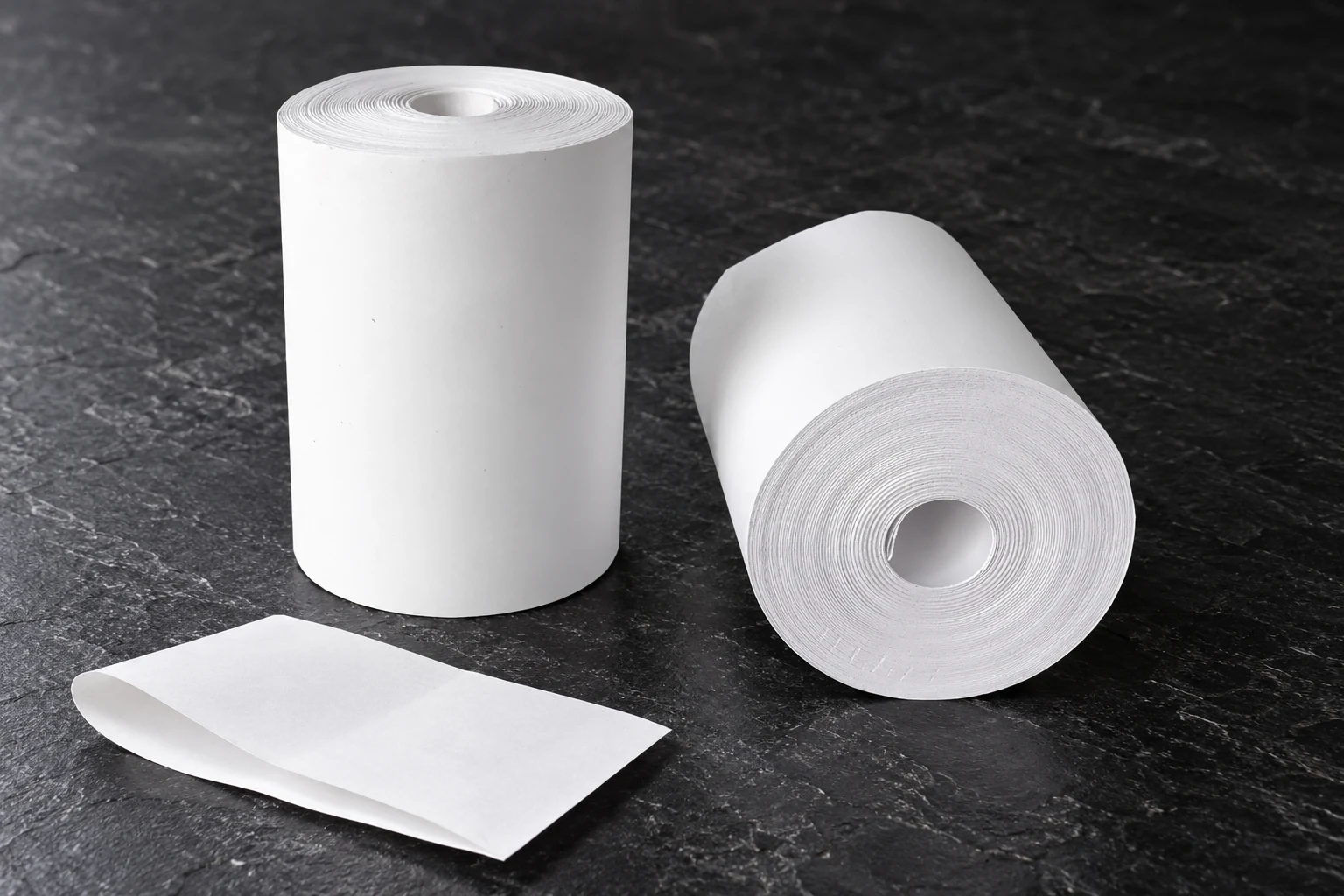
The centre construction can be relevant to loading and retention. Some applications use a cardboard core, while others use coreless rolls. These should be treated as distinct specifications, with compatibility checked against the actual printer. Coreless does not mean universally compatible, and the presence of a cardboard core does not by itself indicate a better roll. The appropriate construction depends on the equipment and handling requirements.
Make the loading orientation unambiguous
Thermal media has an imaging side, and the correct orientation depends on the printer's paper path. A distributor's instructions should align with the equipment guidance so that staff do not interpret a blank print as a paper failure before checking loading. Clear loading illustrations can help, but they must represent the actual device rather than a generic terminal with a different feed direction.
Test feeding under the intended operating conditions
A practical sample trial should include loading, printing, cutting and handling, using the intended equipment and settings. The team should record the conditions so that a poor result can be investigated. Dust, a worn component, an unsuitable setting or incorrectly loaded media can affect observations. A trial that changes several variables at once makes it harder to distinguish a paper issue from an equipment issue.
Receipt roll dimensions belong in the trial record alongside the product code and batch identification. If one sample is accepted, the subsequent order should describe the same specification rather than merely referring to the sample's appearance. This connection helps a buyer investigate a later difference without guessing whether the roll, printer or handling conditions changed.
Match print quality to the receipt's purpose
A receipt may be read immediately at a checkout, scanned for a transaction reference or retained for later review. These uses create different practical questions. Initial print darkness is relevant, but it is not the only consideration. Readability of small characters, barcode performance where applicable, and the conditions experienced after printing can all matter to the customer.
| Use situation | Question to resolve | Suitable verification approach |
|---|---|---|
| Busy retail checkout | Does the roll load, feed and cut consistently? | Trial the agreed roll on the actual printer under recorded settings. |
| Receipt with a barcode | Is the printed code usable in the intended workflow? | Check scanning with the relevant printer output and receiving device. |
| Customer retention | What exposure and retention conditions are expected? | Review the grade's supported performance and handling guidance. |
| Multi-branch distribution | Can staff identify the correct approved roll? | Use clear stock codes and a maintained printer-to-roll mapping. |
| Long distribution route | Will packaging and storage protect the media? | Review transit conditions, packaging and incoming inspection criteria. |
Avoid treating image retention as a universal number
Thermal media performance depends on the grade and the conditions under which it is used and stored. A retention statement should therefore identify the basis on which it applies. Heat, light and contact with certain substances can affect thermal paper. Buyers should not convert a broad marketing statement into a guarantee for receipts left in a hot vehicle, exposed to sunlight or stored with incompatible materials.
For till rolls used in a workflow that requires reliable long-term records, the business should assess whether the paper record alone is appropriate. A separate digital record may be part of the operational design, depending on the organisation's requirements. That decision should not be confused with a claim that every thermal receipt will remain readable for the same period in every environment.

Specify the paper grade and any chemical claims precisely
The commercial description should identify the paper construction and the claims the buyer actually needs. A statement about one chemical does not establish the absence of every other substance, and a general environmental phrase does not define a test method. Buyers should ask what a declaration covers and which product or grade it refers to. This makes the claim checkable without inferring composition from the colour of the paper.
Keep declarations attached to the supplied material
A supplier declaration or report should correspond to the agreed material and its stated scope. The buyer should understand whether it relates to the base paper, the coated paper or the finished converted roll. Changes in source material may require the supporting information to be reviewed. A document that once supported a different grade should not silently become evidence for every item in a supplier's range.
The site's thermal-paper range can help identify relevant product categories for discussion. The final purchase specification still needs to resolve the grade, dimensions, centre and pack details. A category page or product image is useful discovery material, but it is not a substitute for the agreed technical description and appropriate supporting records.
Plan storage around the real distribution route
Thermal media storage should protect unprinted rolls from unsuitable heat, light and contact conditions. Guidance from thermal-paper manufacturers, including Ricoh, identifies exposure risks that can affect appearance and image performance. The applicable handling instructions should come from the grade supplied. A distributor should communicate those conditions through the chain rather than assuming that an intact shrink wrap solves every storage concern.
Review the route as well as the warehouse
For supply into Malaysia, the actual route may include port handling, local delivery, a central warehouse and individual branches. The relevant conditions depend on that route, not simply on the country name. A buyer should identify where cartons may be exposed and how the agreed packaging protects them. Any claimed protection needs to match the material and configuration being ordered.
Thermal media storage instructions should be practical for branch staff. Cartons can be identified by product and batch, kept in suitable locations and rotated using an agreed stock policy. Unclear codes or mixed cartons make it harder to trace an issue back to a specific shipment. Clear identification supports investigation without turning every printing problem into an assumption about the whole supply lot.

Turn the agreed roll into a repeatable order
A purchase description should combine receipt roll dimensions, media type, centre construction, winding requirements and packaging. It can also identify agreed inspection criteria and the records needed for any special claim. These details make quotations comparable. A carton price is difficult to assess if one offer contains a different number of rolls, a different length or a different grade.
Incoming inspection should reflect the risks identified during selection. The buyer may need to check identification, packaging condition and a representative set of agreed characteristics. If a discrepancy appears, the affected stock should be traceable while the cause is assessed. The investigation should retain the printer model, settings, roll identification and observed behaviour rather than relying on a vague report that the paper is bad.
For repeat orders of till rolls, thermal media storage guidance and printer compatibility should remain linked to the approved specification. Equipment changes and material substitutions deserve explicit review. A stable stock code is useful only when the organisation controls what that code represents over time.
Frequently Asked Questions
Is the roll width enough to establish compatibility?
No. Outside diameter, centre requirements, paper type and loading orientation can also matter. The printer's documentation and a controlled sample trial provide a stronger basis than width alone.
Do rolls with the same diameter contain the same length?
Not necessarily. Paper thickness, centre size and winding conditions can differ. Length should be declared on an agreed basis and verified through the method established for the purchase.
Are coreless rolls suitable for every terminal?
No universal compatibility follows from being coreless. The roll construction should match the equipment requirements and loading arrangement. A coreless example should not be substituted for a specified cored roll without review.
Why can thermal receipts change after printing?
The paper grade and exposure conditions affect the image. Heat, light and contact with certain materials can matter. The supplier's grade-specific guidance should inform handling and any statement about retention.
What makes a repeat order easier to verify?
A controlled product code linked to the full specification, clear batch identification and agreed inspection criteria make differences easier to investigate. A familiar carton or roll photograph is not enough to establish equivalence.
A distributor comparing supply options can use the site's thermal-paper selection as a starting point and bring the printer models, required roll construction and distribution conditions into the specification discussion.
 You May Also Like