


 Home
Home XBD
XBD  Jul 31,2026
Direct thermal paper manufacturers should be compared by how reliably they turn printer limits, operating conditions, and buyer tolerances into measurable production controls. A roll can look correct on a desk yet fail through tight winding, excess diameter, poor image response, dust, curl, or packaging that exposes a heat-sensitive surface before it reaches the checkout.
Start With The Printing System
Direct thermal media is a system: the printer supplies heat and pressure, the coating responds, roll geometry controls feeding, and storage affects the image-forming layer. Begin with a printer matrix listing model, permitted width, maximum diameter, core, thickness range, loading orientation, sensing, cut or tear arrangement, and tail restriction. Official printer instructions confirm that these inputs are device-specific.
Add operating context. Checkout lanes may run long queues and frequent cutter cycles across several printer models. Malaysian distribution can involve warm transport and humid storage, so sealed packing, carton protection, stock rotation, and storage instructions deserve the same attention as nominal size.
Translate Limits Into A Control Plan
Do not send only “80 mm receipt roll.” Ask every candidate to return the same drawing and control plan with nominal values, tolerances, sampling frequency, measurement method, and out-of-limit action.
| System Input | Roll Control | Why It Matters | Useful Evidence |
|---|---|---|---|
| Printer paper path | Width and slit-edge condition | Reduces side drag and skew | Drawing, width results, edge rule |
| Roll compartment | Outside diameter and wound length | Prevents an overfilled roll from binding or blocking closure | Diameter tolerance and length-verification method |
| Spindle or holder | Core inside diameter, material, and roundness | Controls mounting fit and rotation | Core gauge record and approved core specification |
| Printhead energy | Thermal response and image-density window | Connects coating behavior with readable output | Agreed printer test and retained comparison sample |
| Storage and use | Wrap, carton, barrier, and handling | Limits environmental exposure | Pack specification and storage statement |
The site's application overview shows many machines using thermal rolls. Segment the specification accordingly: identify printer families that can share one construction and those that require separate items.
Ask For Coating And Print Evidence
One visual sample cannot define performance. Fix the printer, energy setting, pattern, speed, environment, and evaluation timing. Review solid areas, fine characters, barcodes, quiet zones, background cleanliness, and residue. Ask how base-paper and coating lots are identified, response is monitored, finished rolls are traced, and density shifts trigger investigation. “High sensitivity” alone does not prove printer compatibility.
Thermal media remains sensitive after converting. Official handling guidance calls for cool, dry, dark storage, protection from sunlight and heat, separation from incompatible chemicals, and preservation of protective packaging. The supplier should translate those principles into pack and storage instructions for the route and inventory period.
Inspect Converting And Winding
Review slitting cleanliness, dust removal, winding tension, roll hardness, telescoping, end-face alignment, core centering, tail treatment, and outside diameter. These controls affect feed resistance and usable length even when grade and nominal width match.

Sample more than one carton position. Load rolls into actual printers, observe initial and near-core feeding, run text and barcode patterns, and note cutter behavior. Record lot and carton position. The factory page adds context; qualification still requires the assigned line, item-specific settings, first-off approval, and retained records.
Protect Packing And Repeat Orders
Define individual wrap, roll orientation, inner quantity, carton quantity and dimensions, dividers, weight limit, pallet pattern, label fields, and visible lot code. The carton must both protect rolls and remain practical to count, store, and replenish.
Set change control for base paper, coating input, core supplier, slit width, winding setting, wrap, carton, line, and production site. State which changes require notice, a sample, printer testing, revised documents, or approval. An unchanged item code does not prove unchanged construction.
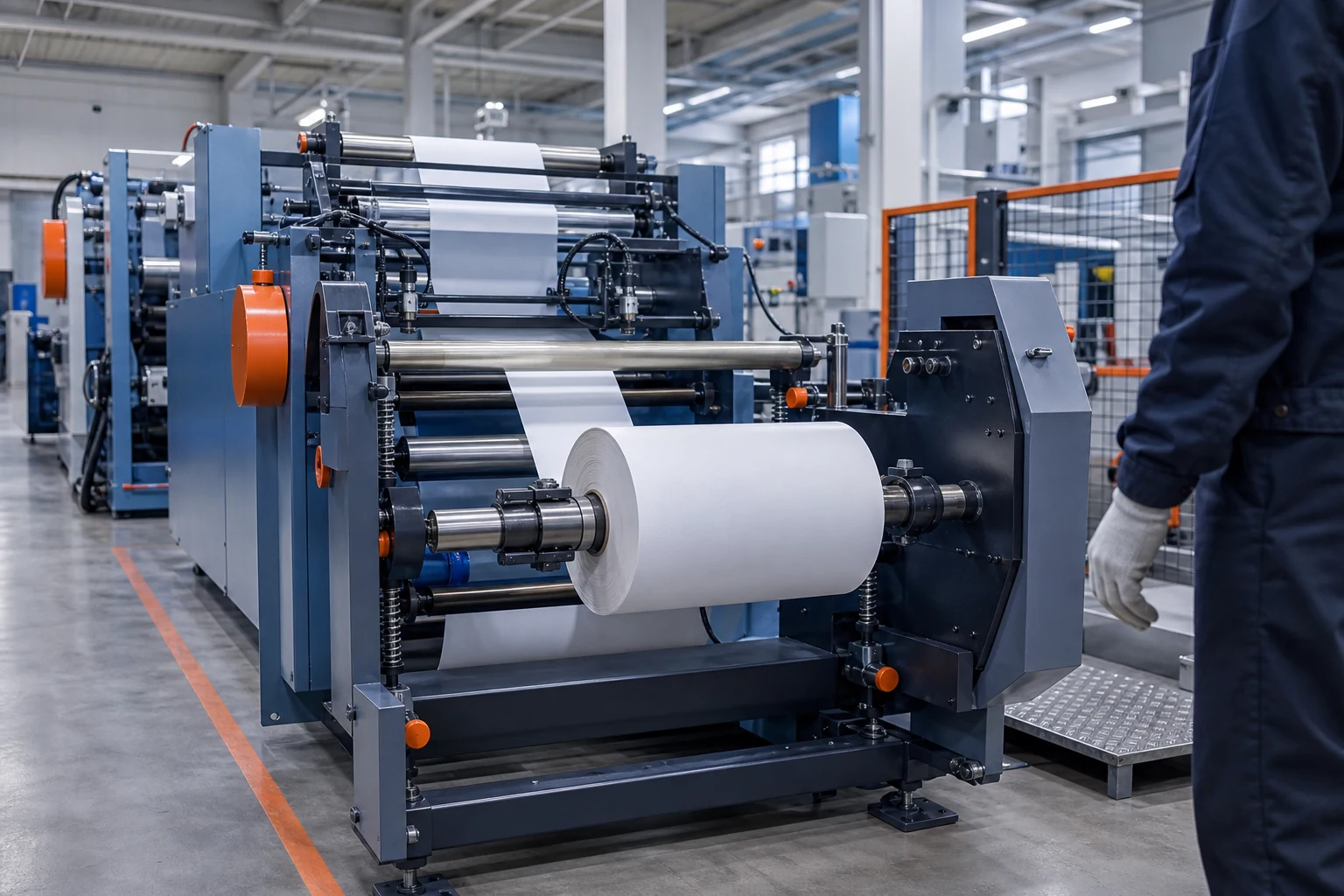
Compare proposals after deviations are explicit. One offer may cover a nearby standard roll; another may include the exact drawing, printer test, sealed pack, and inspection plan. Itemized assumptions put cost beside risk.
FAQ
Is Nominal Roll Width Enough?
No. Include width tolerance, slit-edge condition, outside diameter, core inside diameter, paper thickness or grade, winding expectations, tail treatment, and the printer models used for acceptance.
How Should A Sample Be Tested?
Use the actual printer matrix and a fixed test pattern. Check loading, feeding, image density, fine characters, barcode readability, cutter behavior, dust, curl, and performance near the core. Record settings, environment, lot, and observations.
Why Can Two Equal-Size Rolls Feed Differently?
Nominal dimensions may hide differences in paper thickness, actual diameter, core roundness, winding tension, roll hardness, edge quality, curl, or tail attachment. Those variables change friction and movement through the paper path.
What Storage Information Should Be Requested?
Request recommended temperature and humidity boundaries, protection from light and heat, chemical-separation guidance, expected inventory period, original-pack requirements, carton stacking limits, and a stock-rotation method.
What Makes A Repeat Order Comparable?
Use one controlled item drawing, approved materials, printer-test method, pack specification, sampling plan, lot traceability, and change-notification rule. The item code alone does not prove that the construction is unchanged.
Once the printer matrix, roll drawing, test method, pack configuration, and change rules are defined, send the controlled brief through the site's technical contact channel and request a response that lists every proposed deviation and its effect.
 You May Also Like