


 Home
Home XBD
XBD  Jul 31,2026
Till roll manufacturers are best compared by how accurately they convert real printer, environment, use, and replenishment conditions into a controlled roll brief.
The Checkout Environment Comes Before The Roll
A till roll does not operate in a catalog. It runs inside a specific printer under its actual duty cycle, environment, and replenishment routine. These conditions shape the paper, converting, packing, and acceptance questions a manufacturer must answer.
Begin with the application: device models, printing frequency, receipt length, cutter behavior, storage time, transport route, and whether the paper will be pre-printed. A roll that fits physically can still produce poor results if thickness, coating response, winding, surface condition, or pre-printing is unsuitable for the equipment.
The useful question is not “Do you make this size?” It is “Can you control the complete roll definition that this printer and operating environment require?”
Translate Printer Limits Into A Manufacturer Brief
Printer documentation is the first technical source, not a universal market convention. One official receipt-printer guide may define paper width tolerance, maximum outside diameter, core dimensions, paper thickness, approved base papers, print-density settings, and pre-printing precautions. Another device can define different limits. The brief should quote the exact model requirements and keep assumptions clearly marked.
| Operating Input | Manufacturing Variable | Evidence To Review |
|---|---|---|
| Printer model and compartment | Width, outside diameter, core, winding orientation | Device manual cross-check and dimensional inspection record |
| Receipt volume and length | Usable paper length, thickness, winding consistency | Declared roll construction and sample length verification |
| Print density and speed | Thermal sensitivity and coating response | Printer trial under the intended settings |
| Pre-printed artwork | Ink compatibility, printed area, curing, recording-surface behavior | Approved artwork and application-specific print trial |
| Storage and transport | Wrap, carton protection, heat and moisture exposure | Packing specification and agreed handling limits |
The Same Diameter Can Hide A Different Run Length
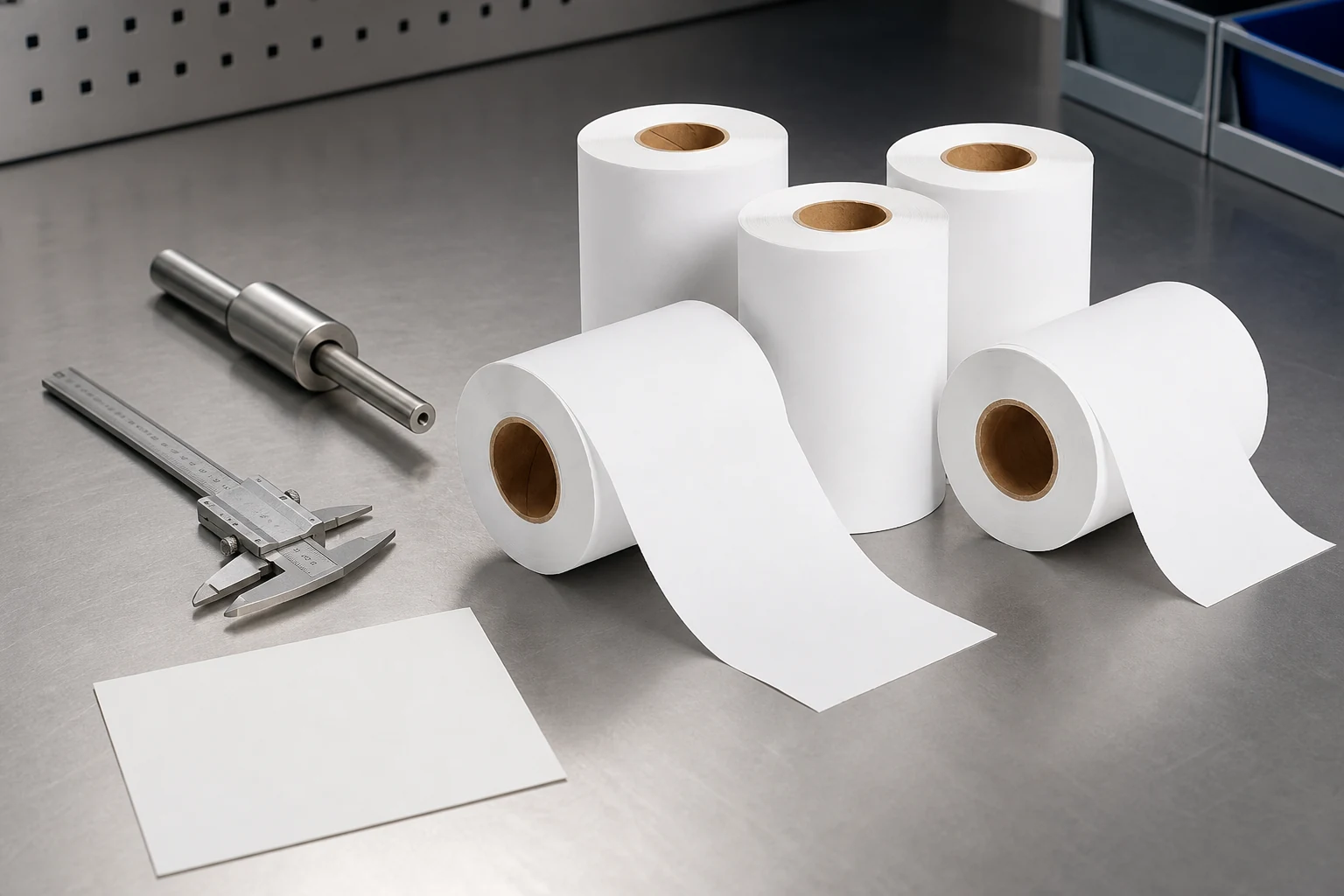
Outside diameter is visible, but it does not fully describe the amount of usable paper. Core diameter, paper thickness, winding tension, and edge alignment all influence the length that fits inside the same apparent roll. A comparison based only on unit price and nominal diameter can therefore reward a materially different construction.
Require the manufacturer to state how roll length is defined and checked. Clarify whether the figure is nominal, minimum, or average; how samples are conditioned; how the core is treated; and what tolerance applies. If run length matters operationally, compare expected receipts per roll only after the average receipt length and print behavior are defined.
Converting Discipline Shows Up At The Register
Slitting and rewinding turn a large paper web into a small machine component. Width control affects tracking; edge quality affects dust and feeding; winding tension affects roll shape; core alignment affects rotation; and cut-off condition affects loading. These are converting outputs, not merely raw-paper properties.
A useful factory review follows the material path. Ask where width, diameter, core, winding, splice, and appearance are checked; how nonconforming rolls are separated; and how carton labels connect finished rolls to a production lot. The answer should describe checkpoints and records, not only machine speed.

Judge Customization By Output Control
A long option list can hide weak definition. Custom width, diameter, core, paper grade, pre-printing, wrap, carton count, and private packaging are useful only when each option becomes an approved specification with a verification method. The manufacturer's role is to identify interactions: a larger core changes usable length, thicker paper changes capacity, and artwork can change print-head behavior.
Use the site's application routes to identify relevant environments, then test the chosen construction in the actual printer population. For high-throughput checkout use, include loading time, cutter performance, image density, dust, curl, and end-of-roll behavior in the trial. Record deviations before approving a production configuration.
- Map every device model and operating condition.
- Convert those inputs into one controlled roll specification.
- Approve representative samples against the same checklist.
- Freeze packing, carton identification, and change notification.
- Monitor repeat deliveries with the acceptance points that matter at checkout.
FAQ
What Information Should Be Sent To A Till Roll Manufacturer?
Send printer models, required paper type, width and diameter limits, core details, winding orientation, thickness or length requirement, pre-print artwork, storage conditions, pack configuration, volume, and the acceptance method.
Is Roll Size Enough To Confirm Compatibility?
No. Physical fit is only one condition. Paper thickness, thermal response, surface treatment, winding, pre-printing, and printer settings can also affect feeding and image quality.
How Should Roll Length Be Compared?
Compare length only after core diameter, paper thickness, conditioning, measurement method, and tolerance are aligned. For operational planning, define an average receipt length before estimating receipts per roll.
Why Does Pre-Printing Need A Printer Trial?
Ink, coverage, curing, and placement can interact with the recording surface and thermal head. Test the final artwork and paper combination under the intended device settings before approving production.
What Proves A Manufacturer Can Repeat The Approved Roll?
Look for a controlled specification, incoming and in-process checks, lot identification, inspection records, approved packaging, change notification, and delivery samples that continue to meet the same acceptance points.
When the device matrix and operating conditions have been converted into a single roll brief, use the contact page to confirm which construction, sample checks, packing details, and documented deviations will apply to that exact configuration.
 You May Also Like