


 Home
Home XBD
XBD  Aug 03,2026
Carbonless Copy Paper buying decisions improve when buyers define ply sequence, grammage, thickness, imaging tests, printer fit, packaging, and receiving controls. A suitable order aligns those requirements with coating position, sheet or roll geometry, perforation, collation, and storage. When decisions remain implicit, two samples that look similar on a desk can perform differently during printing, handwriting, separation, archiving, or a repeat order.
Start With the Form Workflow and Assign Every Ply a Job
Use CB, CFB, and CF Positions Deliberately
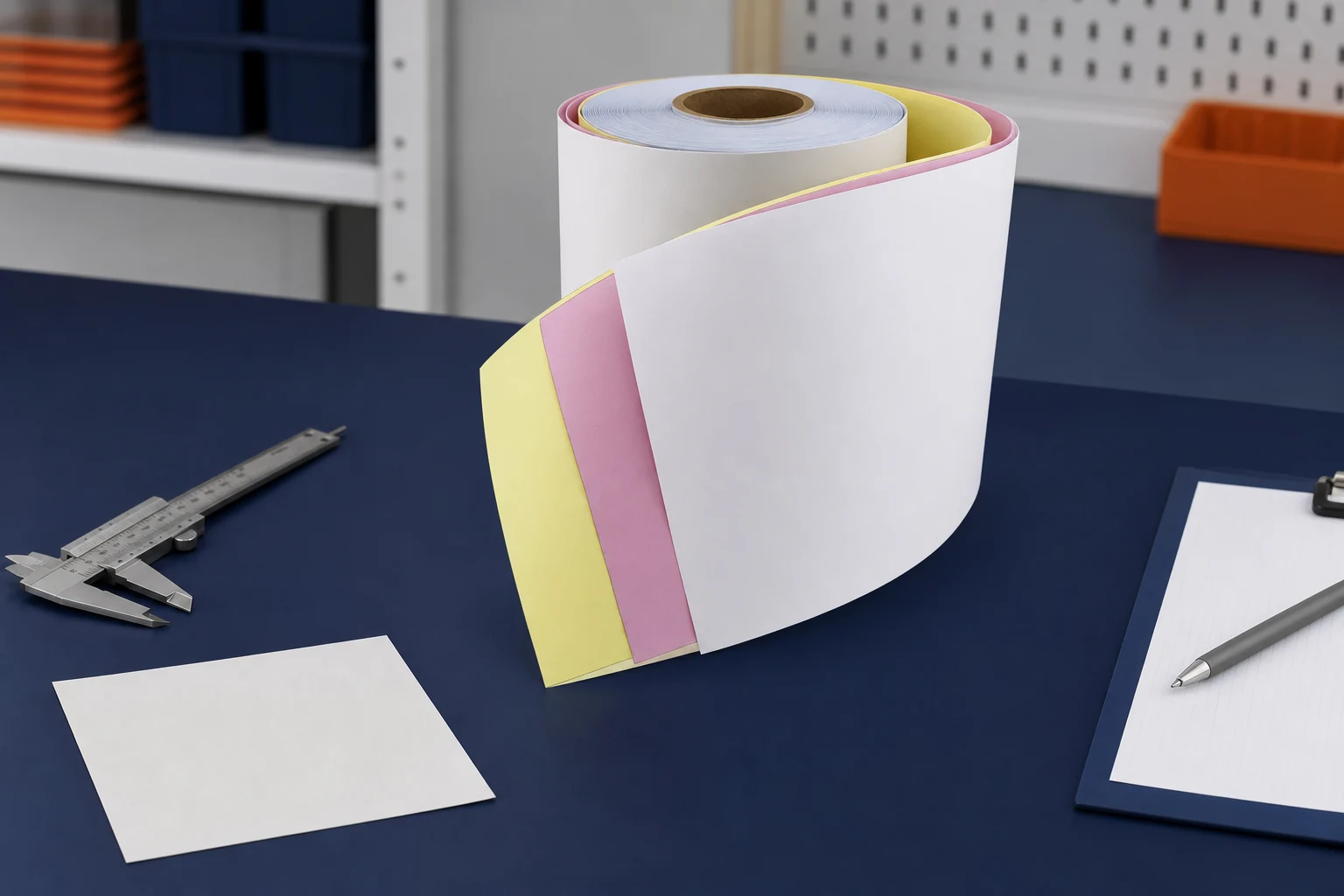
In a conventional CB CFB CF paper set, the top CB sheet carries a coated back, intermediate CFB sheets carry a coated front and back, and the final CF sheet carries a coated front. Pressure releases the image-forming system between compatible surfaces. The purchase order should state the copy order, recipient color, imaging method, and presentation rather than merely request “three colors,” because color routes a copy while coating position determines whether information transfers.
Translate Store and Warehouse Tasks Into Form Requirements
A wholesaler serving supermarkets may need forms for deliveries, internal transfers, returns, equipment maintenance, cash-office records, or supplier claims. Each task determines the number of accountable copies, required fields, writing pressure, filing period, barcode or handwriting area, and whether the last copy must be scanned. A buyer can create one approved use-case matrix and prevent branches from ordering visually similar but incompatible sets.
- Name the original recipient and every copy recipient in the required sequence.
- State whether imaging comes from handwriting, dot-matrix impact, numbering, or another process.
- Define sheet, continuous-form, roll, pad, fan-fold, or unit-set presentation.
- Record separation, binding, filing, scanning, and retention conditions.
Convert the Use Case Into Measurable Paper and Machine Specifications
NCR paper specifications should separate nominal values from tolerances and identify the test method. Grammage and thickness are related but not identical: coatings, fiber structure, moisture, and compression can change caliper at the same nominal weight. ISO 536 describes a method for determining grammage, while ISO 534 covers single-sheet or pack thickness and related density calculations. A buyer does not need to reproduce a laboratory standard in the purchase order, but should name an agreed method and sampling basis.
Define Size, Grammage, Thickness, and Machine Direction
For cut sheets, record finished width, length, squareness, machine direction where it matters, and acceptable dimensional variation. ISO 216 provides A- and B-series context for trimmed writing-paper sizes, yet a custom business form still needs its own controlled drawing. For continuous stock, add web width, fold length, perforation pitch, sprocket-hole position, edge margin, roll diameter, core inner diameter, winding direction, splice policy, and allowable telescoping.
Connect Dimensional Tolerances to the Actual Print Path
Paper that runs well in one device can misfeed in another because guides, tractors, cutters, sensors, bends, heat, and stack pressure differ. The buyer should provide the machine model or a measured path description, maximum form thickness, feed orientation, speed range, and any preprinted or numbered zones. For pads or handwritten sets, the relevant constraints may instead be backing stiffness, writing pressure, adhesive edge, perforation tear, and set alignment.
A practical sample trial uses the intended printer and the longest likely production run, not a few manually fed sheets. Record skew, double feeding, jams, dust, curl, static, fold burst, perforation behavior, registration, and stack quality. The approved sample code and test conditions should accompany the purchase specification so a repeat lot is compared against a traceable reference.
Use an Acceptance Test That Measures the Last Copy
Test Image Density, Definition, and Unwanted Background Together
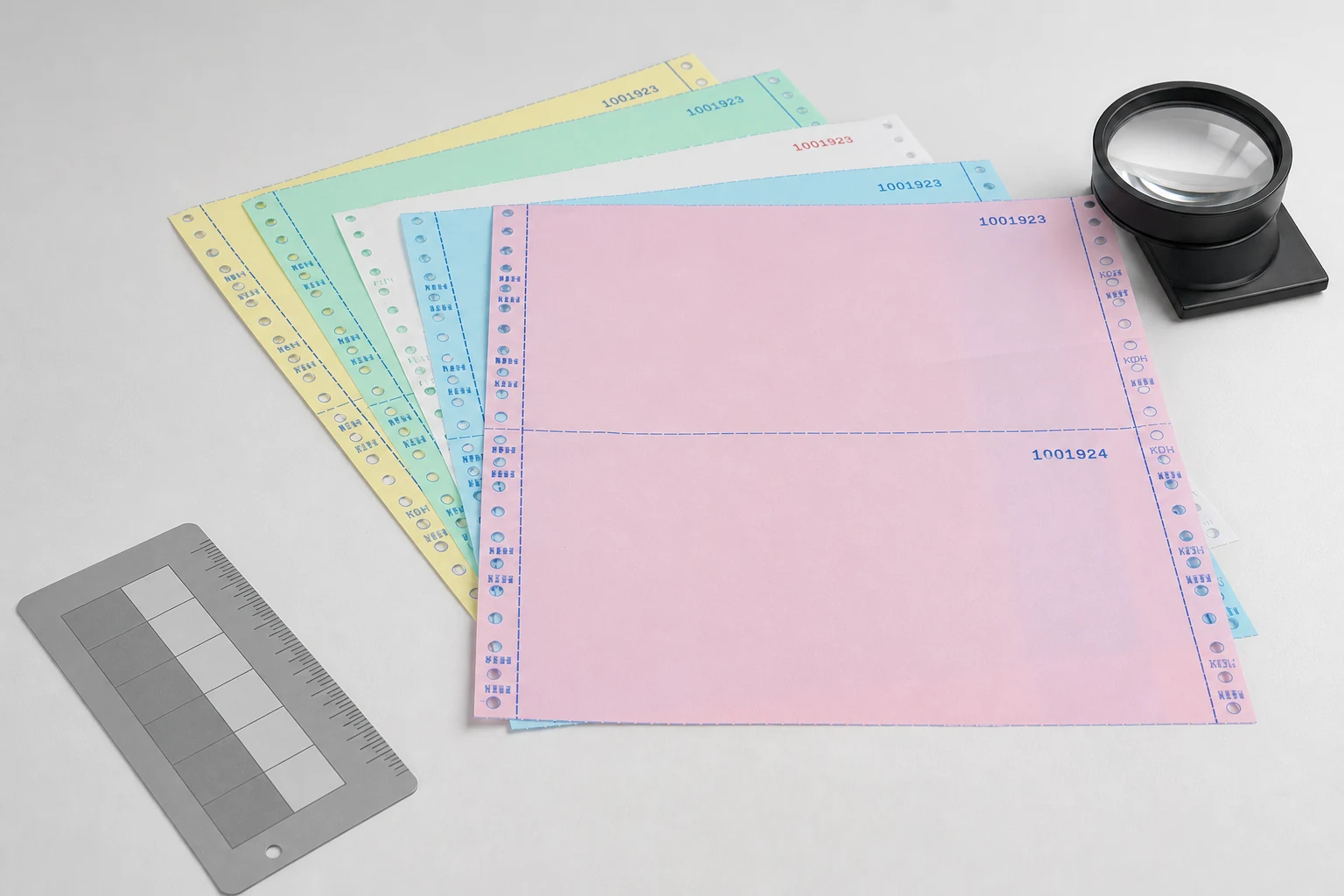
Evaluate the original and every copy for legibility, edge definition, missing strokes, filled characters, uneven transfer, offset, smudging, and background coloration. Include light strokes, dense fields, small type, signatures, numbers, and any barcodes that the workflow requires. If optical scanning matters, define the scanner settings and recognition threshold instead of relying only on human vision.
Condition Samples and Set a Realistic Record-Life Requirement
Temperature and relative humidity affect paper dimensions, curl, static, surface response, and feeding. The buyer should agree on sample conditioning before laboratory or machine tests, then separately assess expected storage and use conditions in Malaysia. Warehouse heat, high humidity, direct sunlight, chemical contact, pressure from stacking, and incompatible packaging can change performance even when the incoming sample passed.
“Long-lasting image” is not a useful specification without a required period and environment. State how long each copy must be readable, whether it will be scanned, how it will be filed, and which accelerated or real-time evidence the supplier can provide. Environmental attributes should also be documented rather than assumed. For example, a recovered-fiber requirement can be requested with evidence, while compatibility, image performance, and local recycling acceptance still need separate review.

Control Printing, Perforation, Collation, and Packaging as One Process
Multi-part business forms are converted products. Base paper can meet its stated values while finished forms fail because of reversed plies, register shift, weak or aggressive perforation, adhesive migration, incorrect numbering, damaged edges, poor winding, or mixed cartons. The purchase specification should therefore cover incoming paper, conversion settings, in-process checks, finished inspection, packing, and release records.
Approve Artwork and Conversion Features Against a Controlled Drawing
Artwork approval should identify the file revision, page size, safe zones, copy-specific text, colors, numbering sequence, barcodes, perforations, sprocket holes, glue positions, and any desensitized areas. If selected areas must not image, request a physical proof and verify both suppression and nearby transfer. The three-part product format and five-ply format show available product directions, but a buyer drawing remains the controlling definition.
During conversion, sample the start, middle, and end of a run or use another agreed frequency. Check ply order, front/back orientation, print register, numbering continuity, image transfer, fold alignment, hole position, perforation strength, pad adhesion, roll tension, and set count. Record how nonconforming material is isolated and how a restart is approved after adjustment.
Make the Carton and Pallet Preserve the Approved Result
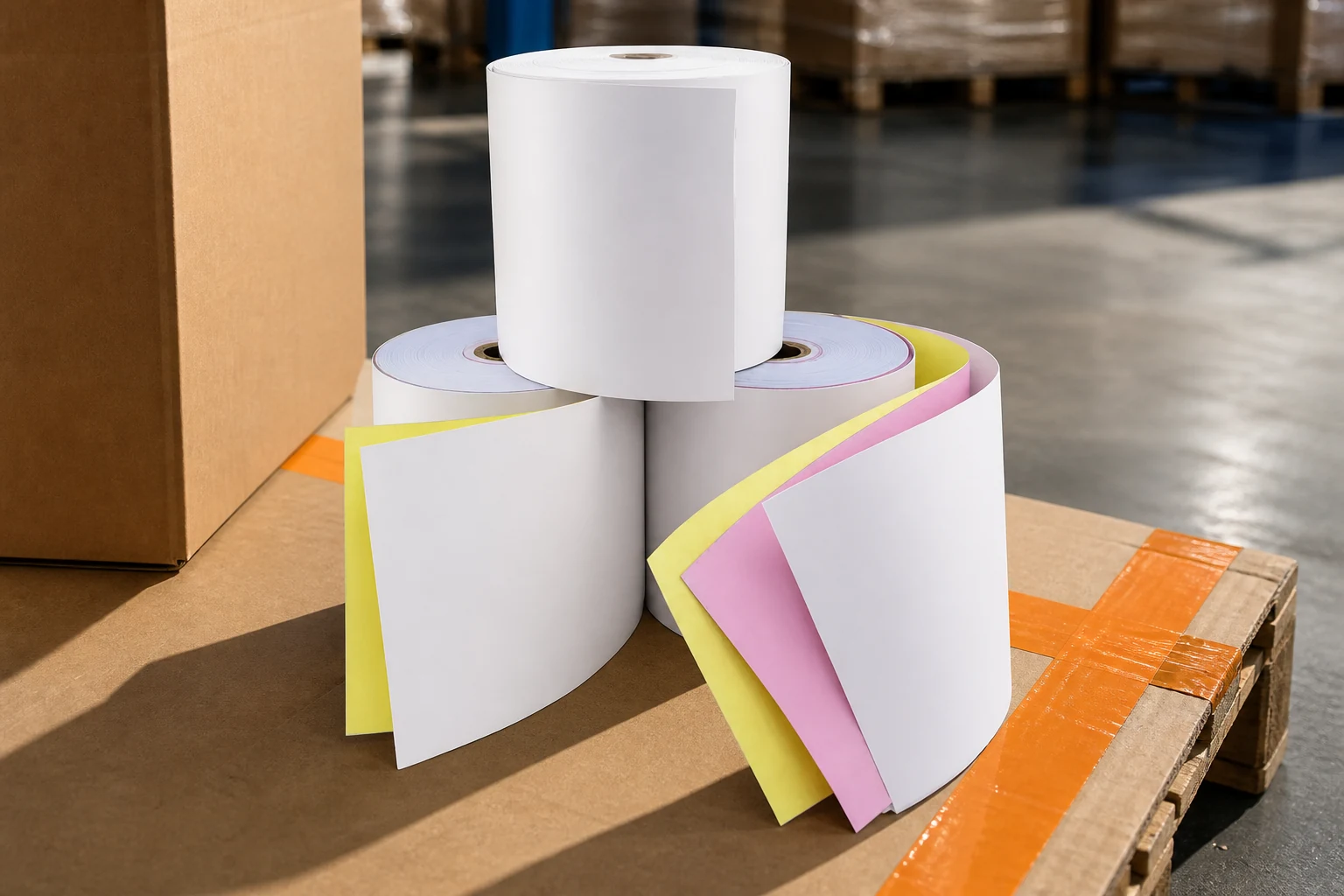
Packaging should protect against moisture, pressure marks, edge damage, curl, dust, and mixed identification. Specify inner wrap, moisture barrier where justified, set or roll count, carton strength, orientation, labels, lot code, pallet pattern, maximum stack, corner protection, and container-loading limits. A generic “export carton” does not reveal whether the final copy will arrive flat and usable.
The factory-direct carbonless product page and manufacturer product page can help buyers identify options to question. Capability statements should be connected to a dated sample, current production site, written specification, and lot record. The site's factory overview is likewise a starting point for diligence, not a substitute for order-specific evidence.
Normalize Quotations Before Choosing a Supply Route
Use a Bid Matrix That Connects Price to Evidence
A bid matrix should show the supplier response, supporting document, exception, owner, and decision date. Ask who controls base-paper sourcing, coating, printing, collation, packing, and subcontractors; then define notice and approval rules for changes. For a repeat program, include retained samples, lot traceability, complaint response, replacement terms, and how obsolete printed stock will be handled after artwork changes.
| Decision Area | Controlled Requirement | Evidence or Test | Common Gap |
|---|---|---|---|
| Construction | Ply count, CB/CFB/CF positions, color order, recipient | Coded sample and construction declaration | Quotation lists colors but not coating positions |
| Paper | Grammage, caliper, dimensions, tolerances, direction | Agreed method, lot results, receiving sample | Nominal values have no tolerance or sampling rule |
| Imaging | Last-copy density, definition, handling marks, scan need | Controlled pressure or printer trial across all plies | Only the top copy is photographed |
| Conversion | Register, holes, folds, perforation, numbering, glue | Approved drawing and start/middle/end inspection | Artwork proof is approved without a physical form test |
| Packaging | Barrier, count, lot code, carton, pallet, stack limit | Pack specification and receiving inspection | “Export packing” is the only description |
| Commercial | MOQ, overrun, tooling, tests, freight, lead time, rework | Itemized quotation and exception list | Low unit price excludes required setup or verification |
For suppliers targeting supermarket and wholesale programs, the site's application overview and company profile can frame follow-up questions. Final approval should depend on the matching sample, specification, test plan, packaging record, and commercial exceptions rather than a general capability list.
Frequently Asked Questions
What Is the Difference Between Two-Part and Three-Part Carbonless Sets?
A conventional two-part set uses a top CB sheet and a final CF sheet. A three-part set adds an intermediate CFB sheet. The needed construction depends on recipient count and workflow, so confirm coating positions, color order, imaging pressure, and last-copy performance with a coded sample.
Is Grammage Enough to Confirm Printer Compatibility?
No. Grammage helps describe paper mass, but caliper, total set thickness, stiffness, curl, moisture, surface friction, perforation, static, and feed geometry can also affect the device. Test the complete finished form in the intended machine under representative run conditions.
How Should Carbonless Copy Paper Be Tested at Receiving?
Confirm item and lot identity, dimensions, ply order, coating orientation, count, packaging condition, and visible damage. Then sample image transfer across all copies, unwanted handling marks, perforation or separation, and machine feed where applicable. Keep the result and a retain sample against the lot.
Can Recovered-Fiber Content Be Added to the Specification?
Yes, if it is relevant to the procurement policy and supported by evidence. Define the required percentage, evidence, and verification route, then separately confirm imaging, converting, storage, and equipment performance. An environmental attribute does not by itself prove functional suitability.
What Information Makes a Carbonless Copy Paper Quote Comparable?
Use the same ply construction, dimensions, tolerances, grammage, thickness, print and numbering scope, perforation, tests, packing, order quantity, overrun, freight basis, lead-time definition, tooling, payment, and rework rules. Record every exception instead of comparing unit price alone.
Buyers can send the controlled form drawing, machine details, ply sequence, quantity, test method, and packaging checklist through the supplier's contact page; any response should be verified against a coded sample and written acceptance plan before a repeat order is approved.
 You May Also Like